
ESG Solutions

ESG Scoring & Management Software for Enterprises

ESGreen is a comprehensive digital platform for ESG management and scoring, helping enterprises automate the collection of non-financial data, quantify Environmental – Social – Governance indicators, and generate Sustainability Reports in accordance with GRI Standards and IFRS S1/S2. The platform supports enterprises in meeting disclosure requirements under Circular No. 96/2020/TT-BTC and Green Credit assessment criteria under Circular No. 17/2022/TT-NHNN. The solution helps enterprises improve the transparency of their assessment documentation, optimize compliance costs, and expand opportunities to access preferential financing from international financial institutions.

Contact Us

What Is ESG Scoring?

ESG scoring is the process of quantifying and comprehensively assessing a company’s non-financial performance across three pillars:Environmental – Social – Governance.

The scoring framework is standardized based on international standards and frameworks such as GRI Standards, IFRS S1/S2 and CDP, together with disclosure requirements under Circular No. 96/2020/TT-BTC.

An ESG scorecard is not only a measure of transparency and climate risk management capability, but also an important “passport” that helps enterprises access Green Credit under Circular No. 17/2022/TT-NHNN, attract sustainable investment capital, and overcome increasingly stringent requirements in international supply chains.

Which Enterprises Need ESG Scoring?

  • Listed Companies & Public Companies
    Fulfil mandatory disclosure requirements on Environmental and Social impacts in Annual Reports in accordance with Circular No. 96/2020/TT-BTC and requirements of the Ho Chi Minh City Stock Exchange (HOSE) and Hanoi Stock Exchange (HNX).
  • Enterprises Seeking Green Credit & Investment Funds
    Meet environmental and social risk assessment requirements of commercial banks under Circular No. 17/2022/TT-NHNN in order to access preferential loan packages, issue Green Bonds, and attract sustainable investment capital from international financial institutions.

  • Exporters & Enterprises in Global Supply Chains
    Ensure transparency of emissions data (Scope 1, Scope 2 and Scope 3) as well as labour and gender equality indicators to meet stringent technical requirements such as sustainable supply-chain due diligence, the CBAM mechanism, and deforestation-related regulations.
  • Enterprises Seeking to Optimize Governance & Reduce Operational Risks
    Use ESG scores as a modern management tool to identify compliance gaps, reduce energy and material costs, and strengthen long-term competitiveness.

Challenges in ESG Implementation

  • Lack of Standardization in ESG Frameworks & Materiality Matrices
    Enterprises often struggle to navigate different international frameworks such as GRI Standards, IFRS S1/S2 and CDP, together with domestic requirements under Circular No. 96/2020/TT-BTC.
    This can lead to incorrect identification of material topics relevant to the enterprise’s specific industry.
  • Fragmented Data and Lack of Audit Trails
    Operational data is often scattered across different departments such as: (HSE, HR, Accounting, Operation), manual data collection through Excel can lead to errors, inconsistencies and a lack of digital supporting evidence for independent assessment and verification.
  • Complexity in Quantifying Emissions & Specialized Indicators
    Enterprises may face significant challenges in calculating Scope 1, Scope 2 and Scope 3 GHG emissions in accordance with the GHG Protocol, as well as quantifying Social and Governance indicators. These limitations can make it more difficult to meet Green Credit assessment requirements under Circular No. 17/2022/TT-NHNN.
  • Lack of Visualization & Industry Benchmarking Tools
    Without a real-time dashboard, enterprises find it difficult to: monitor ESG implementation progress; identify compliance gaps; compare performance with industry averages; make timely decisions for improvement.

ESGreen provides a comprehensive digital ecosystem that helps enterprises standardize non-financial data, automatically calculate ESG scores in real time, and transparently and consistently manage their sustainability roadmap. From advanced quantitative functions and an optimized five-step ESG assessment process to support for Green Credit applications and global supply-chain requirements, ESGreen helps enterprises turn compliance challenges into sustainable competitive advantages.

ESG Scoring Solution from ESGreen

ESGreen provides a specialized software platform that enables enterprises to automate the collection, standardization and comprehensive quantification of Environmental – Social – Governance indicators in real time. The system simultaneously integrates Vietnamese regulatory requirements, including Circular No. 96/2020/TT-BTC and Circular No. 17/2022/TT-NHNN, with leading international standards such as GRI Standards and IFRS S1/S2.

The solution enables enterprises to:

  • self-assess their level of compliance;
  • identify data gaps;
  • benchmark performance against industry peers;
  • automatically generate transparent Sustainability Reports;
  • prepare documentation for Green Credit assessment;
  • respond to requirements throughout global supply chains.

KEY FEATURES

  • Multi-Source Data Collection & Standardization
    Assign data-entry permissions to individual departments such as HSE, HR, Finance and Operations. Digitize supporting documents and attach evidence to help ensure data integrity and maintain a transparent audit trail.
  • ESG Assessment Based on Multiple Standards
    Automatically map ESG indicator matrices across Vietnamese requirements, including: Circular No. 96/2020/TT-BTC, Circular No. 17/2022/TT-NHNN & and international frameworks such as GRI Standards, IFRS S1/S2.
  • Automated Scoring Algorithm & Emissions Quantification
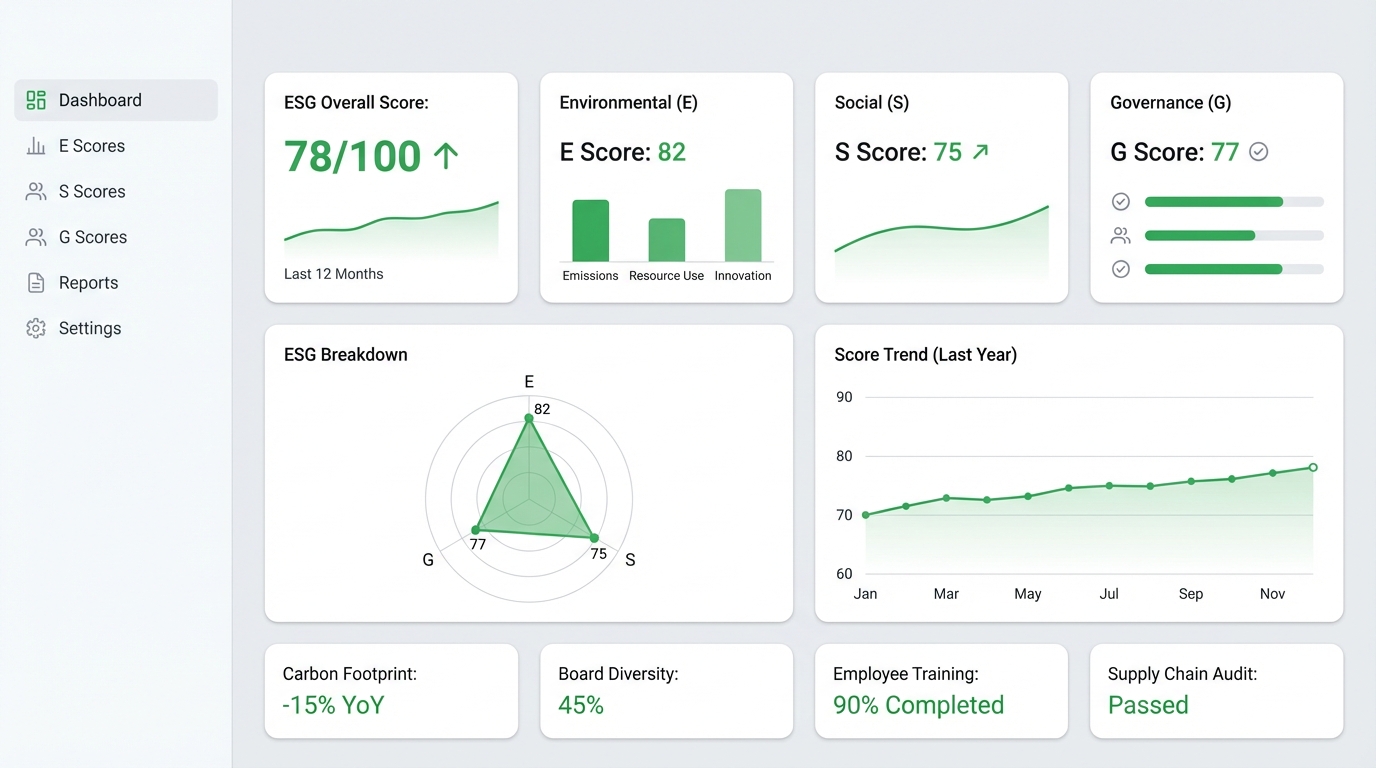
    Automatically convert energy consumption data into Scope 1, Scope 2 and Scope 3 greenhouse gas emissions. The system calculates individual E – S – G scores as well as an overall ESG score based on industry-specific weighting.
  • Real-Time Performance Visualization Dashboard
    Monitor overall ESG performance through multi-axis radar charts, trend charts, KPI scorecards. This allows management to quickly understand the enterprise’s current compliance and ESG performance status.
  • Gap Analysis & Industry Benchmarking
    Compare enterprise performance against industry averages, identify high-risk indicators, and provide specific recommended actions to improve ESG performance and ranking over time.
  • Automated Sustainability Reporting
    Generate complete reports compatible with Annual Report requirements under Circular No. 96/2020/TT-BTC & the GRI Content Index. Reports can be used to support Green Credit applications and respond to requirements from international partners.

ESG Scoring Process

  • Step 1: Define ESG Criteria & Industry Weightings

Select an appropriate assessment framework based on the enterprise’s size and industry. Establish a materiality matrix for Environmental – Social – Governance indicators aligned with: GRI Standards; IFRS S1/S2; Circular No. 96/2020/TT-BTC.

  • Step 2: Assign Responsibilities & Collect Cross-Departmental Data

he system provides role-based accounts for relevant departments such as: HSE; HR; Accounting; Risk Management. Each department enters operational data and attaches supporting documentation for verification.

  • Step 3: Automated Reconciliation, Standardization & Emissions Calculation

The platform automatically checks the validity of input data and converts energy and material consumption into Scope 1, Scope 2 and Scope 3 greenhouse gas emissions using standardized emission factors.

  • Step 4: Consolidate Data & Calculate ESG Ratings

The algorithm automatically quantifies detailed scores for each pillar: Environmental – Social – Governance. It then calculates an overall ESG score and generates real-time analytical charts.

  • Step 5: Gap Analysis & Report Generation

Identify criteria that have not yet been met and benchmark enterprise performance against industry averages. Based on the results, the system recommends areas for improvement and automatically generates Sustainability Reports for disclosure and Green Credit assessment.

Practical Applications

Explore More

FAQ - ESG Scoring

ESG scoring is the process of assessing an enterprise based on three groups of criteria: Environmental – Social – Governance. The scoring results help enterprises identify strengths and weaknesses and monitor improvements over time.

ESG scoring is not currently mandatory for all enterprises in Vietnam. However, it is increasingly becoming a common requirement from investors, stock exchanges and international supply-chain partners. This trend is expected to continue growing in the coming years.

A greenhouse gas inventory is an important component of the Environmental (E) pillar of ESG. CO₂ and other GHG emissions data from the GHG inventory serve as direct inputs for assessing environmental performance in ESG scoring.

ESGreen provides an ESG scoring platform that includes:data collection and standardization; automated E – S – G scoring; visual dashboards; monitoring of improvements over time; ESG report generation aligned with investor requirements.

START YOUR E-S-G ASSESSMENT

Contact the ESGreen team for advice on an ESG scoring solution tailored to the size and industry of your enterprise.

Contact Us