
NET-ZERO CONSULTING

Comprehensive Net-Zero Roadmap Consulting for Enterprises

ESGreen supports enterprises in establishing an emissions baseline, modelling emissions reduction scenarios aligned with the SBTi framework, and developing an energy transition portfolio optimized for investment efficiency. We also provide strategic advice on the use of high-quality carbon credits, enabling enterprises to proactively turn their Net-Zero commitments into action and strengthen their leading position in the green transition.

Request Consultation
What Is Net-Zero?

In line with Vietnam’s commitment at COP26 to achieve net-zero emissions by 2050, as institutionalized in the National Strategy on Climate Change to 2050 under Decision No. 896/QD-TTg, and with reference to the SBTi Net-Zero framework: Net Zero is achieved when an enterprise reduces greenhouse gas emissions across its entire value chain – Scope 1, Scope 2 and Scope 3 – as deeply as possible through a science-based pathway consistent with limiting global warming to 1.5°C, and then neutralizes residual emissions that cannot reasonably be eliminated through equivalent greenhouse gas removals.

Net-Zero vs. Simple Carbon Offsetting

A Net-Zero roadmap places primary emphasis on direct emissions reduction at source, including: improving energy efficiency; transitioning to cleaner technologies and energy sources; electrification; reducing emissions across the supply chain. Carbon credits and other offsetting mechanisms should primarily be used to neutralize residual emissions that remain difficult to eliminate toward the long-term target.

Which Enterprises Need a Net-Zero Roadmap?

  • Facilities Subject to Emissions Allowance Allocation
    This includes facilities in three key sectors: Thermal Power, Iron & Steel, Cement. These enterprises need a structured decarbonization roadmap to manage compliance with allocated emissions allowances, proactively manage allowance surpluses or shortages, and optimize the use of eligible carbon credits within the applicable regulatory framework.
  • Exporters Facing Cross-Border Carbon Requirements (CBAM, CSDDD, EUDR)
    Manufacturers and exporters supplying the EU, the United States and other demanding international markets are increasingly expected to provide transparent Scope 1, Scope 2 and Scope 3 emissions data and demonstrate credible emissions reduction pathways. A structured decarbonization strategy can help enterprises respond to mechanisms and requirements such as CBAM, CSDDD and EUDR, while strengthening their position in international supply chains.
  • Multisector Corporations, FDI Enterprises & Global Supply-Chain Suppliers
    Many enterprises receive direct climate requirements from global partners such as Apple, Samsung, Nike and other multinational corporations.These requirements may include: setting science-based emissions reduction targets; transitioning to clean energy; reducing supply-chain emissions; improving Scope 3 transparency.
  • Listed Companies, Public Companies & ESG Leaders

    Enterprises increasingly need a systematic decarbonization strategy to improve ESG performance, strengthen information disclosure, and increase opportunities to access: green credit; green bonds; sustainable finance; international investment funds.

Challenges in Developing a Net-Zero Roadmap

  • Lack of Standardized Methodologies & International Target-Setting Frameworks
    Enterprises may struggle to determine which framework – such as SBTi, ISO 14068-1 or the GHG Protocol – should be used to establish appropriate near-term, medium-term and long-term climate targets.
  • Incomplete and Unverified Baseline Emissions Data
    Many enterprises do not yet have a comprehensive and reliable greenhouse gas inventory covering Scope 1, Scope 2 and material Scope 3 emissions. Fragmented and inconsistent data can significantly affect the accuracy of decarbonization scenario modelling.
  • Balancing Economic Feasibility & Technology Choices
    Enterprises often lack tools for assessing the economic feasibility of different emissions reduction measures. This includes comparing: CAPEX, OPEX, ROI, Emissions Reduction Potential across solutions such as energy efficiency, renewable energy transition, electrification and low-carbon technologies.
  • Lack of Dynamic Monitoring & Credible Carbon Offsetting Mechanisms
    Without a structured monitoring system, enterprises may find it difficult to track emissions reduction performance over time. They may also face challenges in identifying high-quality carbon credits to address residual emissions transparently at the final stage of the Net-Zero pathway.

ESGreen provides an integrated Net-Zero roadmap consulting solution that combines internationally recognized methodologies with the enterprise’s actual emissions data. 

ESGreen’s Net-Zero Consulting Solution

ESGreen provides specialized Net-Zero strategy consulting that closely integrates actual GHG inventory data with internationally recognized methodologies such as SBTi and ISO 14068-1.

We support enterprises throughout the process — from establishing an emissions baseline and modelling emissions reduction scenarios to developing a portfolio of energy transition and low-carbon technology solutions tailored to each industry.Our approach directly connects climate objectives with business economics by helping enterprises:

  • Optimize investment costs through MACC and ROI analysis;
  • Proactively respond to carbon pricing mechanisms such as ETS and CBAM;
  • Prioritize cost-effective decarbonization measures;
  • Build long-term competitive advantages across global value chains.

Key Consulting Areas

  • Emissions Baseline Establishment & Current-State Assessment
    Collect, standardize and quantify Scope 1, Scope 2 and material Scope 3 emissions in accordance with the GHG Protocol and ISO 14064-1.The resulting emissions baseline provides the technical foundation for the entire Net-Zero roadmap.
  • Science-Based Emissions Reduction Target Setting
    Support enterprises in establishing near-term emissions reduction targets and long-term Net-Zero targets consistent with a 1.5°C pathway and the enterprise’s business development strategy.
  • Decarbonization Solution Portfolio & MACC Analysis
    Assess technical interventions including: energy efficiency; renewable energy transition; electrification; low-carbon technologies; supply-chain optimization. A Marginal Abatement Cost Curve (MACC) is used to compare emissions reduction potential and costs, helping enterprises prioritize investments.
  • Scenario Modelling & Detailed Implementation Roadmap
    Model the Business-as-Usual (BAU) emissions scenario against different climate-action scenarios across key milestones (2030-2040-2050). The roadmap integrates emissions reduction targets with projected CAPEX/OPEX, technology requirements and implementation priorities.
  • MRV System & Carbon Offsetting Strategy

    Develop a structured Measurement – Reporting – Verification (MRV) process to regularly monitor emissions reduction progress. For residual emissions that are difficult to eliminate, ESGreen advises enterprises on appropriate high-quality carbon credits and carbon removal options.

Net-Zero Roadmap Development Process

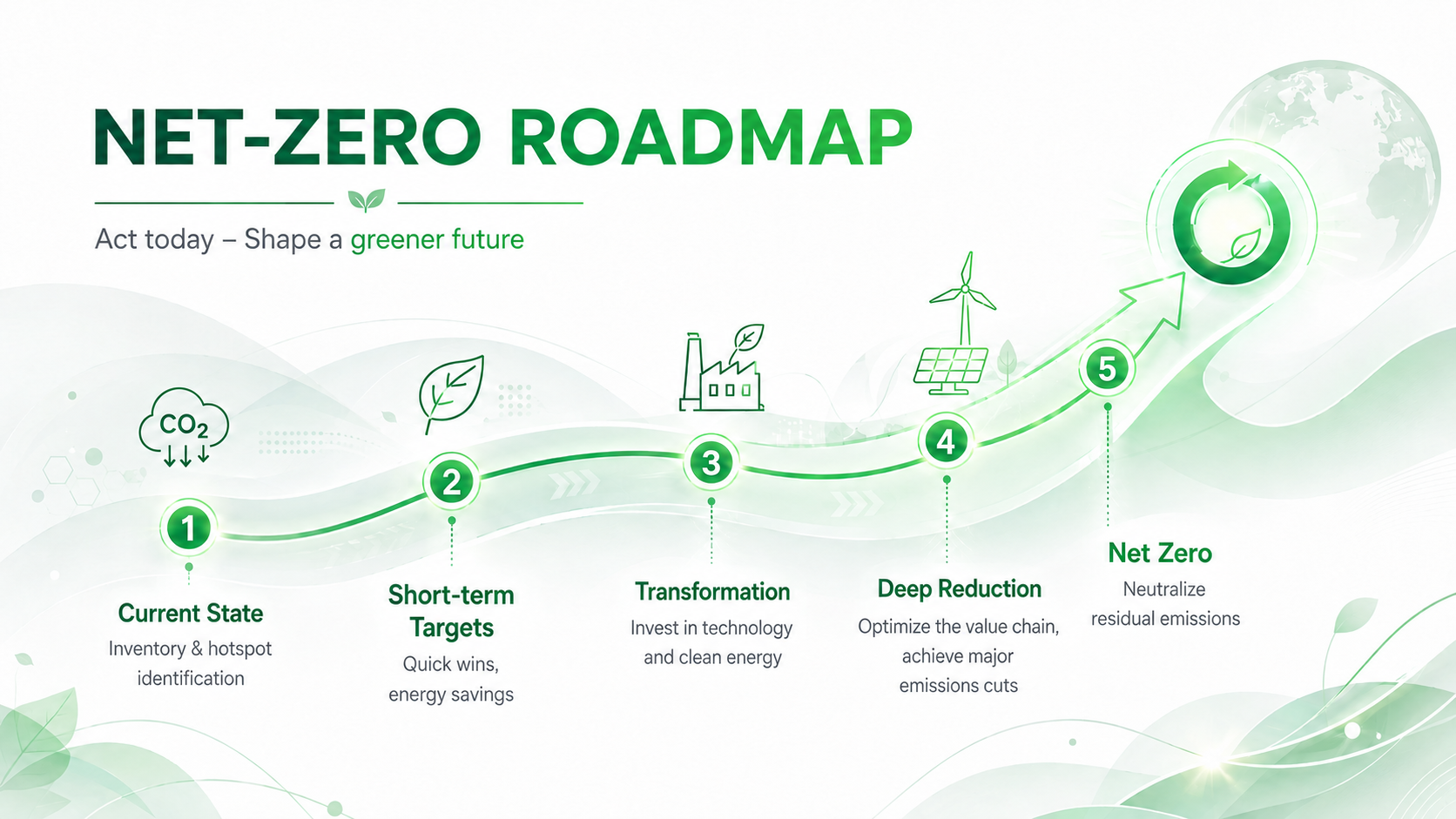
  1. Assessment & Carbon Footprint Measurement
    Conduct energy assessments, collect activity data and quantify total greenhouse gas emissions across Scope 1, Scope 2 and Scope 3 to establish a reliable base year.
  2. Gap Analysis & Scenario Modelling
    Assess the gap between current emissions and the enterprise’s emissions reduction targets based on applicable frameworks such as SBTi or ISO 14068-1. Develop a Business-as-Usual scenario and alternative emissions reduction scenarios.
  3. Strategy Development & Abatement Cost Optimization
    Screen potential technologies, energy-transition measures and supply-chain interventions. Develop a Marginal Abatement Cost Curve to optimize CAPEX/OPEX allocation across the milestones of 2030, 2040 and 2050.
  4. Implementation Support & Value-Chain Integration
    Support enterprises in implementing: energy-efficiency initiatives; low-emission operating models; renewable and clean energy transition; supplier engagement; Scope 3 reduction initiatives; a portfolio of high-quality carbon credits where appropriate.
  5. MRV System & Periodic Verification
    Establish annual greenhouse gas Measurement – Reporting – Verification procedures. Actual emissions reduction performance is compared against planned targets so that the roadmap can be periodically reviewed and adjusted to reflect changing technologies, regulations and market conditions.

Practical Applications

FAQ - Net-Zero Consulting

Net Zero is a state in which greenhouse gas emissions have been deeply reduced and the remaining residual emissions are balanced by an equivalent amount of greenhouse gas removals. The ultimate objective is to bring net greenhouse gas emissions to zero.

Net Zero is not currently a universal mandatory requirement for all enterprises in Vietnam. However, it is becoming increasingly important as Vietnam works toward its national commitment to achieve Net Zero by 2050, while international customers, investors and supply chains continue to strengthen their emissions reduction requirements.

The timeframe depends on the size of the enterprise, the coverage of Scope 1–3, data readiness and the complexity of its operations. A Net-Zero roadmap normally includes both near-term milestones and a long-term target, rather than being treated as a one-time project. For enterprises following the SBTi framework, the long-term Net-Zero target should be aligned with 2050 or earlier.

ESGreen provides comprehensive consulting services, including:

  • Assessment of current emissions;
  • Establishment of an emissions baseline;
  • Development of emissions reduction scenarios;
  • Net-Zero roadmap development;
  • Technical solution recommendations;
  • Economic and investment analysis;
  • Progress monitoring and MRV.

Build a Net-Zero Roadmap for Your Enterprise

Contact the ESGreen team for advice on an emissions reduction strategy and a Net-Zero roadmap tailored to your enterprise’s operations, industry and long-term business objectives.

Contact Us