


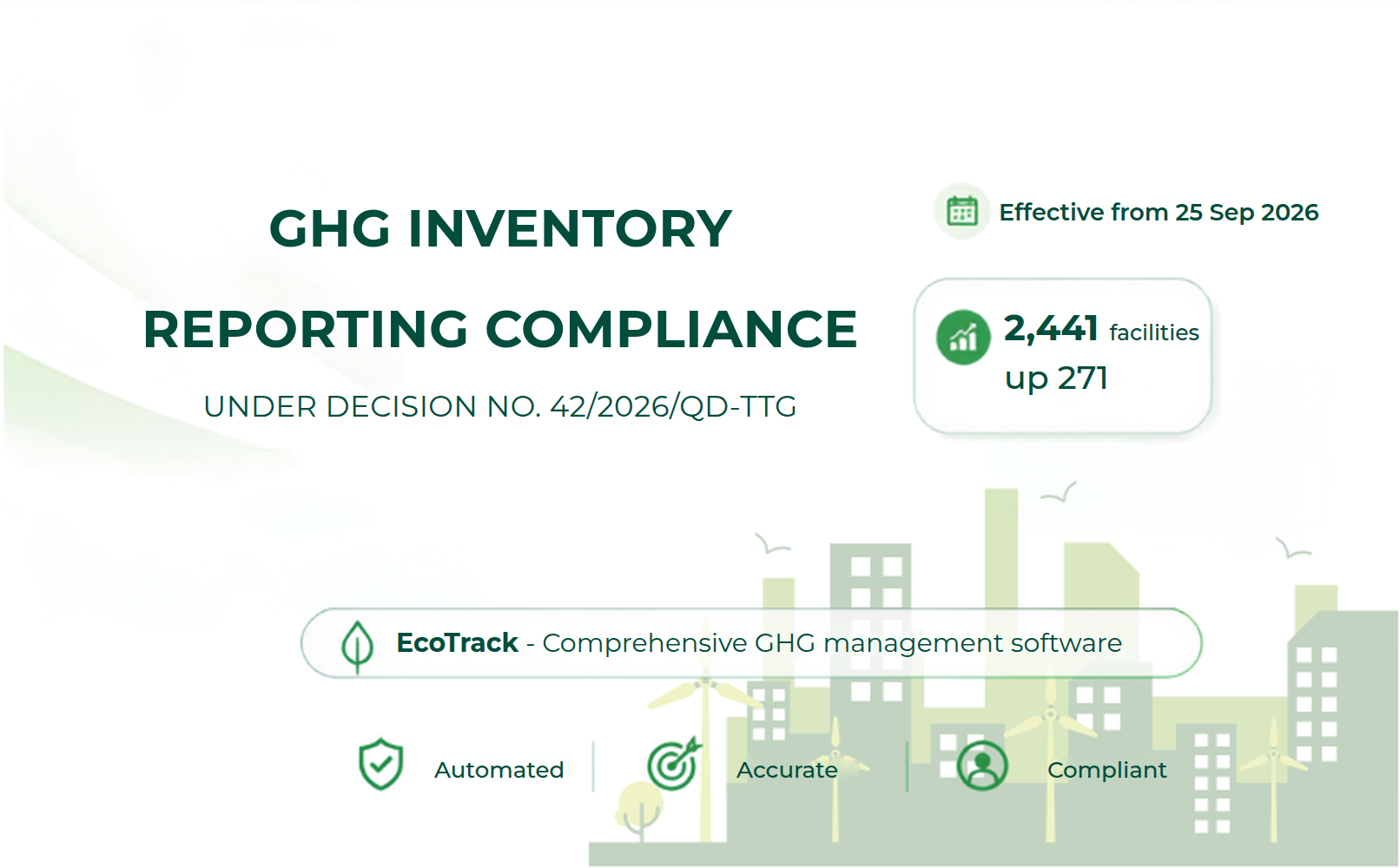
On 10 August 2026, the Prime Minister issued Decision No. 42/2026/QD-TTg promulgating the updated List of Sectors and Greenhouse Gas-Emitting Facilities Required to Conduct Greenhouse Gas Inventories. The Decision takes effect on 25 September 2026 and replaces Decision No. 13/2024/QD-TTg dated 13 August 2024.
Under the updated list, 2,441 emitting facilities nationwide are required to conduct greenhouse gas (GHG) inventories. For businesses, the question is not only whether they must conduct an inventory. More importantly, it is how to prepare data, how to compile reports, and how to turn inventory results into emission reduction plans that meet legal requirements and prepare them for future carbon management requirements.
Part 1. Updated list of sectors and GHG-emitting facilities required to conduct GHG inventories
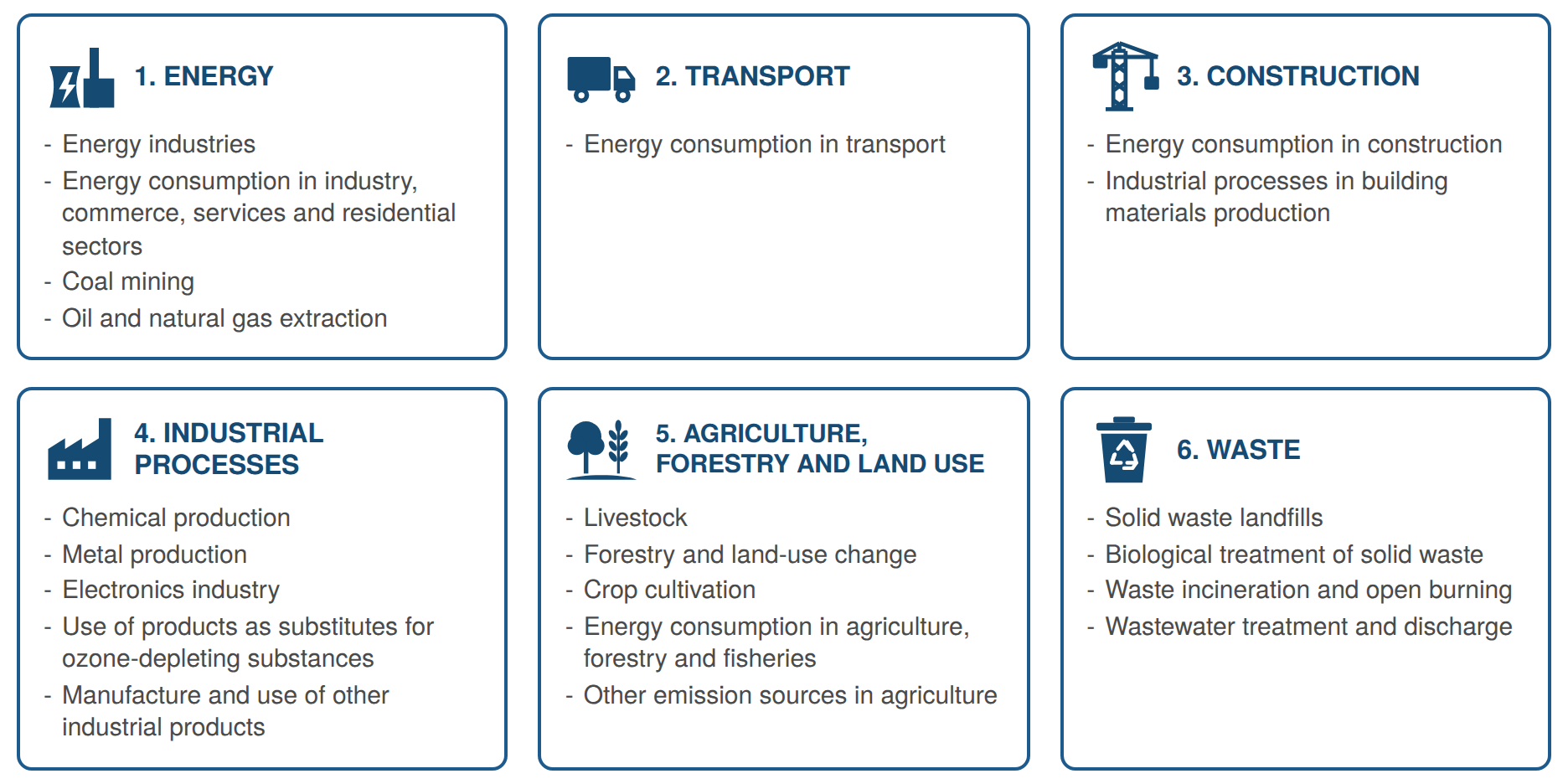
The list of six sectors is the basis for defining the management scope and classifying emission sources subject to sector-level GHG inventories. It is not a list of separate obligations that businesses must carry out on their own. For each facility, the inventory obligation depends on whether the facility is included in the appendices to Decision No. 42/2026/QD-TTg and which sector-managing authority it falls under.
Under Appendices II, IIIA, IIIB and IV of Decision No. 42/2026/QD-TTg, 2,441 facilities are on the mandatory GHG inventory list, broken down by managing sector as follows:
| Sector | Decision No. 42/2026/QD-TTg | Change vs. Decision No. 13/2024/QD-TTg | Current managing authority |
| Total facilities nationwide | 2,441 facilities | Up 271 facilities | |
| Industry and Trade | 1,916 facilities | Up 111 facilities | Ministry of Industry and Trade |
| Construction | 411 facilities | Up 182 facilities | Ministry of Construction |
| Transport | 53 facilities | Down 22 facilities | Ministry of Construction |
| Agriculture and Environment (waste treatment facilities only) | 61 facilities | Up 4 facilities | Ministry of Agriculture and Environment |
Businesses should check the updated list in Decision No. 42/2026/QD-TTg to determine:
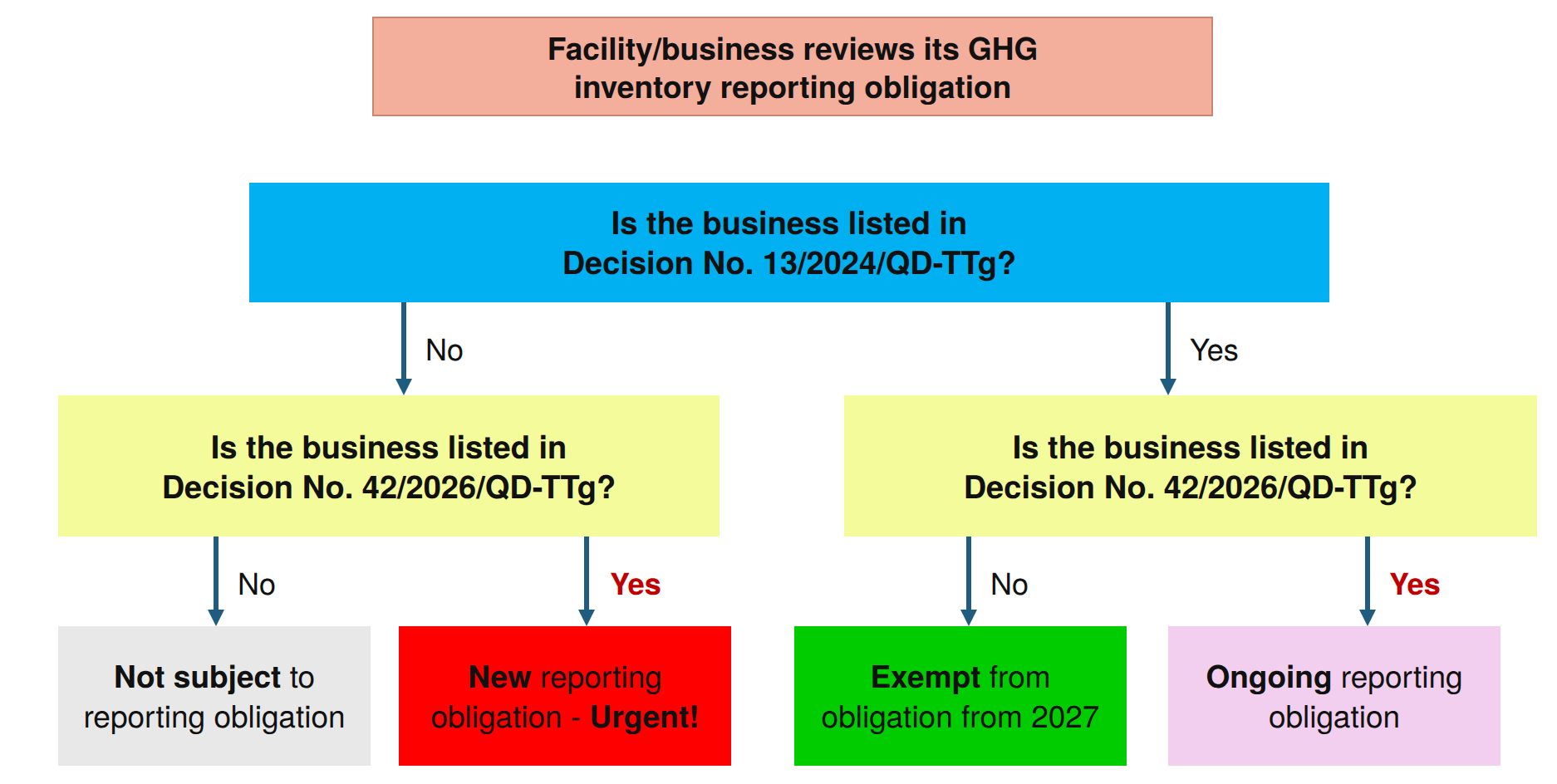
- Whether a facility on the current list remains on the new list;
- Whether a facility has been added to the list for the first time;
- Whether the facility’s scope, sector or managing authority has changed.
Facilities that were listed under Decision No. 13/2024/QD-TTg but no longer appear on the new list under Decision No. 42/2026/QD-TTg will be exempt from submitting facility-level GHG inventory reports from 2027 (applicable to the reporting period for 2026 inventory data).
Part 2. How should Vietnamese businesses comply with GHG inventory reporting?
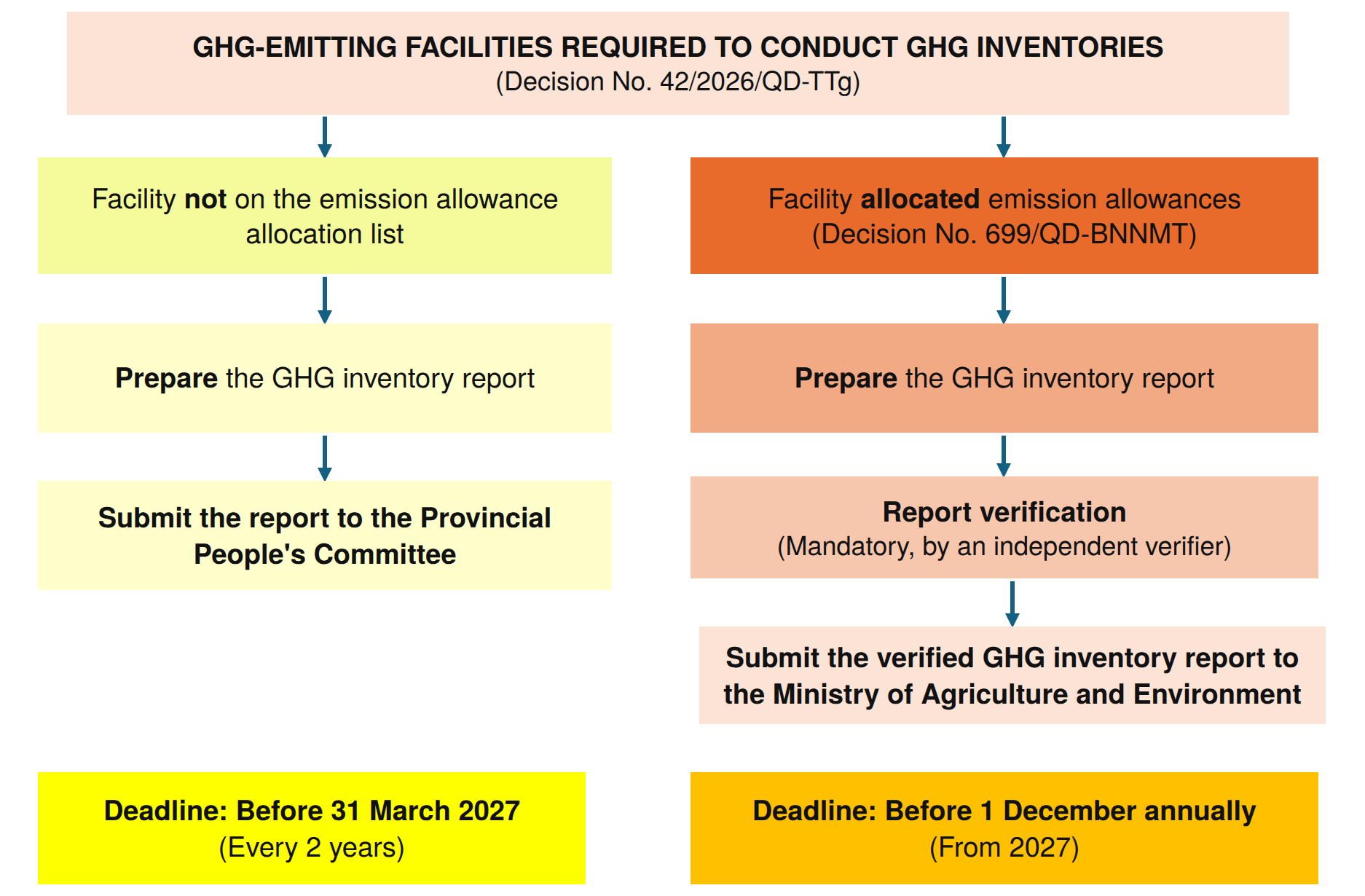
Facilities on the list required to conduct GHG inventories are responsible for organizing their own facility-level GHG inventories in accordance with guidance from the relevant sector-managing ministry. Facilities must prepare and submit GHG inventory reports following the procedures and deadlines set out in Decree No. 06/2022/ND-CP dated 7 January 2022, as amended and supplemented by Decree No. 119/2025/ND-CP dated 9 June 2025.
BIn addition to facility-level GHG inventory reports, Decree No. 06/2022/ND-CP (as amended and supplemented by Decree No. 119/2025/ND-CP) requires listed facilities to develop a Facility-Level GHG Mitigation Plan and a Facility-Level GHG Mitigation Report. The data businesses collect today therefore serves more than a single inventory report. It is also the input for managing and reducing emissions in the years ahead.
| Type of Document | Frequency | Submission deadline | Receiving authority | Applicable form |
| GHG inventory report | Every 2 years | Before 31 March (from 2025), or before 1 December (from 2027, for facilities allocated allowances) | Provincial People’s Committee, or Ministry of Agriculture and Environment (for facilities allocated allowances) | Form 06, Appendix II, Decree No. 06/2022/ND-CP (as amended by Appendix II, Decree No. 119/2025/ND-CP) |
| GHG mitigation plan | Per period (updated annually, if applicable) | Before 31 December 2025 (for the 2026–2030 period) | Ministry of Agriculture and Environment, sector-managing ministries and Provincial People’s Committees | Form 02, Appendix IV, Decree No. 06/2022/ND-CP |
| GHG mitigation report | Annually | Before 31 March each year (from 2027) | Provincial People’s Committee | Form 02, Appendix III, Decree No. 06/2022/ND-CP (as amended by Appendix III, Decree No. 119/2025/ND-CP) |
Part 3. Opportunities and challenges in GHG emissions data management for Vietnamese businesses
With the issuance of Decision No. 42/2026/QD-TTg, 2,441 facilities now have direct obligations related to GHG inventories and mitigation. Based on ESGreen’s experience, these facilities still face the following difficulties and challenges.
- Time pressure
From the issuance of Decision No. 42/2026/QD-TTg to the first reporting deadline of 31 March 2027, facilities have only about seven months to complete GHG inventories for both 2025 and 2026. To meet this requirement, facilities need to become familiar with the guiding circulars of the relevant ministries and with the reporting requirements and forms under Decree No. 06/2022/ND-CP and related legal documents. They also need to retrieve their data from 2025.
Newly listed facilities may not yet have data collection processes, dedicated staff or emissions data management systems in place. If they start preparing only when reports are due, businesses risk a last-minute rush, with data, staff and workload all piling up at the end of the period.
- Data quality and traceability requirements
Beyond reporting total GHG emissions, a GHG inventory report must be able to answer the following questions:
- Where does the activity data come from?
- Is the calculation method appropriate?
- How is supporting evidence stored?
For facilities conducting a GHG inventory for the first time, or still doing it manually, building and maintaining a systematic and complete GHG inventory database that meets reporting standards is a major challenge.
- Coordination across multiple departments
A GHG inventory is not solely the job of the environmental team. Data may sit with production, engineering, accounting, procurement, energy, environment, facility management and other departments. Without clear processes and responsibilities, compiling data can easily lead to errors or gaps.
A GHG inventory also requires continuous collection of detailed activity data over many months, such as fuel and electricity consumption, raw material inputs and waste generated. Data management should be treated as an ongoing process that starts when the data is generated, not when the business begins preparing its report.
To address these issues and avoid shortfalls in capacity and resources, facilities should adopt digital solutions and automated GHG management systems to build a rigorous and effective GHG management and reporting process. ESGreen has developed EcoTrack, a GHG emissions management system designed specifically to support facilities listed under Decision No. 42/2026/QD-TTg.
A reliable GHG management system not only helps businesses meet reporting requirements but also builds a data foundation for long-term carbon management. When emissions data is collected completely, consistently and traceably, businesses can clearly determine their emission levels, identify their key emission sources, and assess the reduction potential of each activity.
As Vietnam gradually builds and operates its carbon market, the ability to measure and manage emissions data will become increasingly important. Businesses that standardize their data early will be better positioned to adapt to carbon management requirements, develop emission reduction plans, and seize opportunities in the future carbon market.
ESGreen is ready to support your business
EcoTrack is ESGreen’s system designed specifically for Vietnamese businesses. It helps facilities produce accurate, transparent and compliant reports automatically, while preparing them for future opportunities. Key features of EcoTrack include:
✔️ Configuration that matches the business’s organizational structure
✔️ Real-time management of GHG emissions and allowances
✔️ Automatic calculation of emissions and uncertainty in line with the latest regulations
✔️ Export report in the required templates for each standard, compatible with the national reporting system
✔️ Convenient storage of data and records for appraisal and verification process
ESGreen’s GHG inventory solution helps facilities stay on top of compliance, reduce pressure, minimize errors, save costs and manage carbon over the long term.
Contact ESGreen for a preliminary review of your facilities in the updated list in Decision No. 42/2026/QD-TTg:
Phone: (+84) 856 357 968
Email: contact@esgreen.vn
Address: 8th Floor, Diamond Flower Tower, 48 Le Van Luong Street, Yen Hoa Ward, Hanoi, Vietnam
Website: https://esgreen.vn/